A dating method with no range attached
Dendrochronology is presented here with a specific comparative edge: unlike radiocarbon dating, which the material states always produces a range rather than a single point, tree-ring dating can assign a piece of wood an exact calendar year. The underlying logic is that each ring represents one year of growth, and the width of that ring reflects the growing conditions during that specific year, wider in favourable seasons and narrower during drought or cold. Because trees growing in the same region experience the same broad climate patterns, their ring-width sequences match closely enough that overlapping patterns from different trees, some living, some long dead, can be strung together into a single continuous chronology extending back centuries or millennia beyond the lifespan of any one tree.
An astronomer chasing sunspots, not archaeology
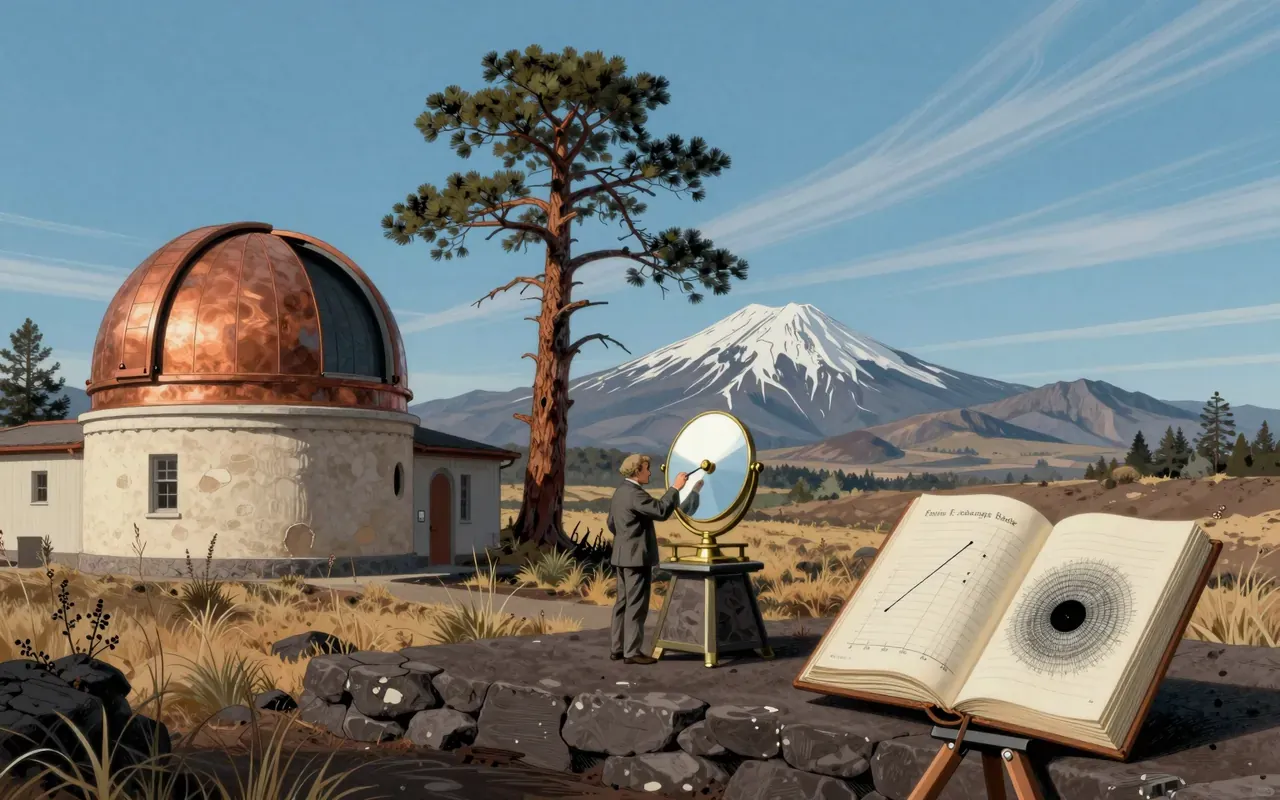
The field’s foundational figure did not set out to study archaeology at all. A. E. Douglass, an astronomer, began examining tree rings in 1894 while working under Percival Lowell, motivated by a hypothesis that sunspot cycles might influence Earth’s climate in a way that would leave a visible trace in tree-ring widths, a reasoning chain the material summarises directly as sunspots affecting climate, which in turn affects tree rings. Douglass coined the term dendrochronology itself in 1928 and went on to found the Laboratory of Tree-Ring Research at the University of Arizona in 1937, formally establishing the discipline as a teaching subject. His path into this work through solar astronomy rather than archaeology or biology is treated as a genuinely unusual origin for a technique that would go on to reshape archaeological dating.
One beam that closed a centuries-long gap
The specific breakthrough that made the method archaeologically powerful came on 22 June 1929, when a wooden beam identified in Arizona, later catalogued as beam HH-39, bridged two previously separate tree-ring chronologies that had not overlapped, producing a single continuous record reaching back to the year 700. This connection allowed Douglass, working with Clark Wissler of the American Museum of Natural History, to assign precise dates to Southwestern archaeological sites, including Pueblo Bonito, dated to the eleventh century, and the Aztec Ruin, dated to between 1111 and 1120. The material frames this single beam as a genuine turning point, converting what had been two disconnected, internally consistent but absolutely undated sequences into one continuously anchored timeline.
Rings that double as a climate record
Beyond dating, tree rings serve as a direct climate record in their own right, a subfield called dendroclimatology. Because ring width tracks moisture and temperature during the growing season, researchers can reconstruct local climate conditions stretching back hundreds or even thousands of years using the same physical rings that provide the date. More recent refinements go beyond simple ring width, measuring maximum latewood density within each ring as a more sensitive climate proxy. This dual function, the same ring simultaneously giving a precise year and a climate signal for that year, is what makes dendrochronology unusually valuable compared with dating methods that only establish age without also carrying environmental information.
Fixing radiocarbon’s own uncertainty
Tree-ring chronologies also underpin radiocarbon dating’s own calibration. Because atmospheric radiocarbon levels have varied over time, raw radiocarbon measurements need to be converted into calendar years using a calibration curve, and the material specifies that German oak sequences reaching back to roughly 8500 BC and Californian bristlecone pine sequences reaching back to about 6700 BC formed the foundational backbone of these curves, with the most recent portion of the modern IntCal20 curve, covering the last 13,900 years, built directly on tree-ring data. This relationship runs both ways: comparing radiocarbon ages against dendrochronological ages has itself been used to confirm that two independently built tree-ring sequences are internally consistent with one another.
From dating log cabins to catching art forgers
The same ring-matching principle extends into an area with no obvious connection to archaeology at first glance: authenticating panel paintings. Because oak and other wood panels can be dated using the felling pattern in their growth rings, dendrochronology has been used to catch forgeries and correct misattributions, including a portrait once attributed to an eighteenth-century artist that ring analysis showed was actually painted on sixteenth-century wood, and several paintings depicting Christ expelling the money-lenders that were ruled out as the work of Hieronymus Bosch because the wood itself postdated his lifetime. Between 1971 and 1982, researchers successfully dated the large majority of a sample of paintings analysed this way. This closing application, taking a technique built to date wooden beams and turning it into an art-historical forensic tool, is what earns the material its hour.