No vestige of a beginning
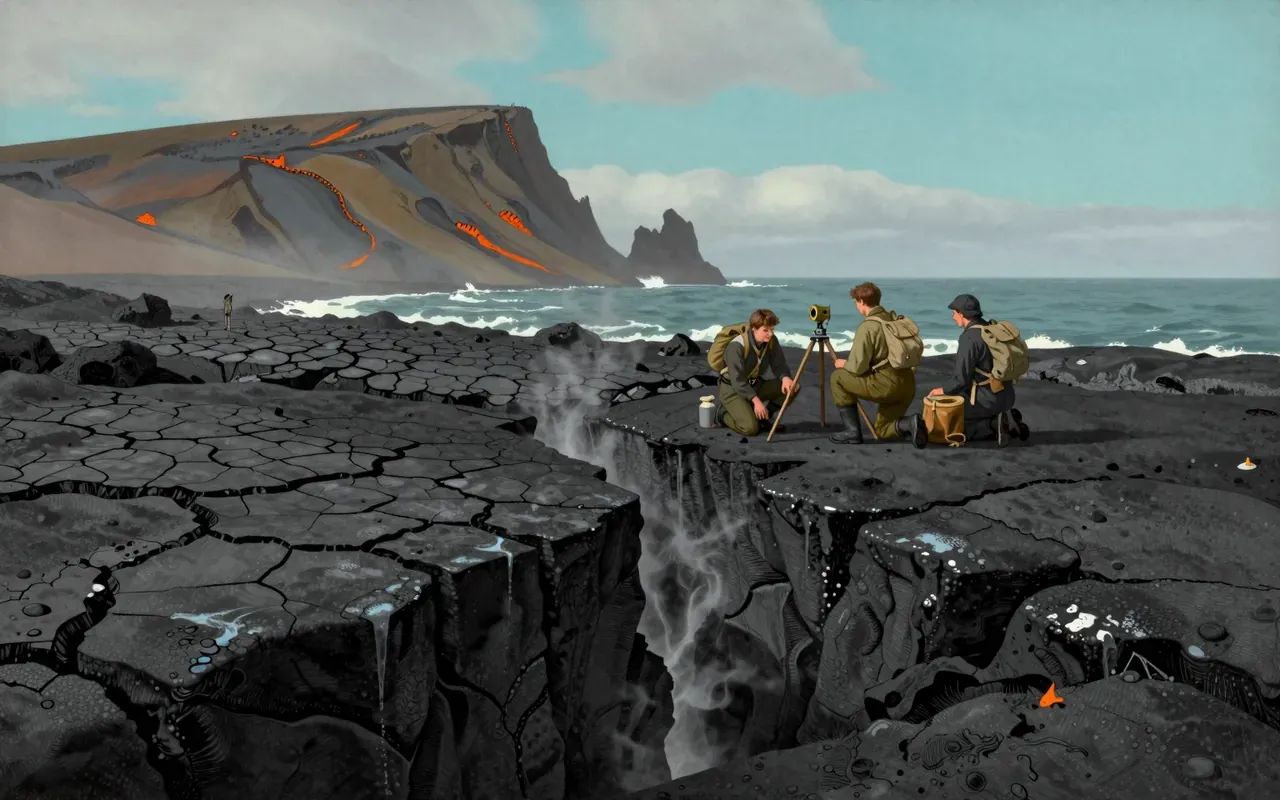
The claim, in its original form, is that the natural processes shaping the Earth today, erosion, deposition, uplift, are the same processes that shaped it in the past, and that reading them carefully lets you infer the planet’s history without invoking anything unobservable. James Hutton set out this view in the 1780s, arguing against the then-dominant idea that most of Earth’s rock layers had been laid down by a single great flood. Examining slow, ongoing processes of deposition and erosion, Hutton concluded that the geological record showed, in his own words, no vestige of a beginning and no prospect of an end, meaning the timescales involved were vastly longer than anything then assumed.
Lyell’s Principles of Geology
It was Charles Lyell who turned this into a systematic and widely read scientific programme. In his three-volume Principles of Geology, published between 1830 and 1833, Lyell argued that the present is the key to the past, laying out related propositions about the uniformity of natural law, method, and the kind and degree of processes at work across time. The philosopher William Whewell, reviewing Lyell’s work in 1832, coined both the term uniformitarianism for this gradualist view and catastrophism for the opposing idea that Earth’s history consisted of violent, sudden episodes separated by calmer periods. Lyell was sharply critical of catastrophism, arguing it discouraged careful scientific investigation.
Naming the sides of a debate
The logical force of uniformitarianism was that if the processes visible today, sedimentation, erosion, mountain-building, work as slowly as they appear to, then producing the thick, complex rock layers actually observed in the field would have required an immense span of time, far beyond the few thousand years implied by traditional biblical chronologies. This was a powerful argument precisely because it did not depend on any single dramatic discovery; it followed from careful, repeated observation of ordinary geological processes and simple extrapolation. Neither Hutton nor Lyell, however, had any physical method for assigning an actual numerical age to the Earth. Their case established that the planet was old, not how old.
An old Earth, but no number
That gap was closed only in the twentieth century, once radioactive decay was understood well enough to be used as a clock. Radiometric dating of rocks and meteorites eventually placed Earth’s age at approximately 4.54 billion years, a figure far larger than even Lyell’s expansive, effectively open-ended sense of geological time. In that sense modern dating vindicated the direction of Lyell’s argument, that the planet was enormously old, while replacing his qualitative reasoning with a precise, independently checkable number. Lyell’s specific view that Earth’s history might be an indefinitely repeating steady state, rather than one with a genuine origin, did not survive this later evidence.
Radiometric dating supplies the figure
Uniformitarianism’s influence reached well beyond geology. Charles Darwin carried the first volume of Lyell’s Principles of Geology aboard HMS Beagle and later credited seeing the landscape through Lyell’s eyes as central to his own thinking, because evolution by natural selection also required enormous stretches of time to operate through small, cumulative changes. The two became close friends after the voyage, even though Lyell himself resisted the theory of evolution for years, offering only a qualified acceptance after On the Origin of Species was published in 1859. The broader point is that establishing deep time as a legitimate scientific premise was a precondition for entire fields, not just geology, to develop as they did.
Room for real catastrophes
This is worth understanding because it shows a scientific idea succeeding by being refined rather than by being simply right or wrong. Later geologists, including work on the Channeled Scablands and what some call neocatastrophism, showed that genuinely sudden, dramatic events, such as large glacial floods, do belong in the geological record alongside gradual change, correcting Lyell’s stronger claim that everything proceeded at a uniform, steady rate. What survives from uniformitarianism is the more modest and durable idea that the same physical laws and processes apply across time, which remains foundational to how geology is practised. Readers who want to understand why deep time became scientifically credible before anyone could measure it precisely will find that story clearly laid out here.