An anomaly in a thin layer of clay
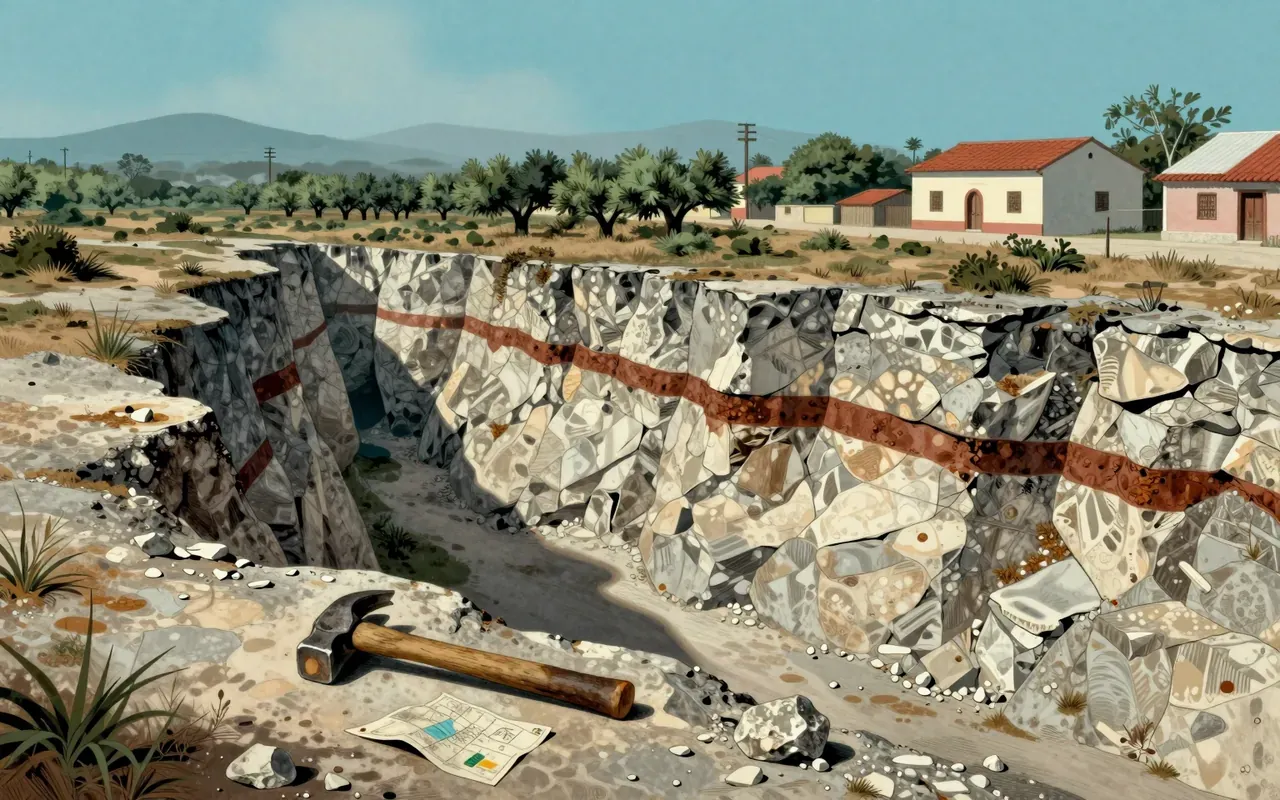
In 1980, the physicist Luis Alvarez, his son the geologist Walter Alvarez, and chemists Frank Asaro and Helen Michel proposed that the mass extinction ending the age of non-avian dinosaurs, roughly 66 million years ago, was caused by the impact of a large asteroid rather than by any gradual, purely earthbound process. Their case rested on a striking chemical anomaly: a thin layer of clay marking the boundary between the Cretaceous and Paleogene periods contained iridium at concentrations tens to well over a hundred times higher than typical in Earth’s crust, and iridium is far more common in asteroids and comets than in most rocks found on the planet’s surface. The claim was specific and testable rather than speculative: something extraterrestrial had struck Earth around the time roughly three-quarters of all species, including every non-avian dinosaur, disappeared from the fossil record.
A predicted crater, found years later
The iridium anomaly alone did not identify where any impact had occurred, and for over a decade after 1980 no confirmed crater of the right age and size had been found. That changed with the identification of the Chicxulub crater, buried beneath Mexico’s Yucatán Peninsula and measuring roughly 180 kilometres across, consistent with an impact by an object some ten to fifteen kilometres wide. Further physical evidence accumulated alongside the crater itself: spherules of rock melted and re-solidified by the impact, shocked quartz grains altered by extreme pressure, and tsunami deposits along Gulf and Caribbean coastlines, all dated to the same boundary layer as the iridium. A 2016 drilling project into the crater’s peak ring recovered granite pushed up from deep within the Earth and found the site lacked the gypsum deposits that would otherwise have vaporised into climate-altering aerosols, adding further physical detail to how the impact’s aftermath unfolded.
From proposal to formal consensus
The asteroid impact explanation has become the scientific consensus, formally endorsed in March 2010 by an international panel of forty-one scientists who reviewed two decades of accumulated evidence and explicitly ruled out volcanism as the primary driver. The physical case has only strengthened since the original 1980 proposal: refined radiometric dating placed the impact and the extinction boundary within the same narrow window, and later climate modelling, published around 2020, favoured the impact’s effects over volcanic ones as the better match for the pace and pattern of the extinction. The impact is estimated to have released energy equivalent to one hundred million megatons of TNT, and its immediate aftermath, an impact winter that blocked sunlight and halted photosynthesis, along with rapid ocean acidification identified through more recent research, offers a mechanism detailed enough to account for why so many different kinds of organisms died out together.
The volcanism debate that hasn’t fully closed
What the asteroid hypothesis has not fully resolved is how much a separate, ongoing episode of volcanic activity in India, known as the Deccan Traps, contributed to the extinction alongside the impact. Some researchers, including the palaeontologist Gerta Keller, have argued the volcanism deserves more weight than the impact-centred consensus gives it, and more recent work has proposed a middle position, suggesting the Chicxulub impact itself may have intensified the Deccan eruptions, making the two mechanisms connected rather than strictly rival explanations. The extinction’s exact duration is also not pinned down to the day: estimates put the main die-off within a window of perhaps less than ten thousand years, precise by geological standards but still a range rather than a single dated event.
Catastrophe, not gradual decline
Beyond settling a specific paleontological debate, the Alvarez hypothesis established a general method, looking for chemical signatures of extraterrestrial material in the geological record, that has since been applied to search for evidence of other possible impacts throughout Earth’s history. It also reshaped how the fossil record’s most dramatic transition is understood: rather than dinosaurs fading out gradually as better-adapted mammals slowly outcompeted them, the evidence points to a sudden catastrophe that cleared ecological space within a geologically short window, after which surviving lineages, including early mammals, birds and fish, diversified rapidly to fill the niches left behind. That distinction between gradual replacement and sudden catastrophe followed by rapid diversification has become a standard framework for thinking about mass extinctions generally, not only the one that ended the dinosaurs.
A method that outlived the debate
This is a well-worn story in popular science, but the material rewards revisiting because the actual evidentiary path, from an anomalous clay layer to a confirmed crater to a formally endorsed consensus three decades later, is more careful and more contested than the compressed popular version usually conveys. It is worth the time for the clarity of the reasoning: a specific, falsifiable prediction, that an impact crater of a particular size and age must exist somewhere, was made in 1980 and confirmed only years later, in a sequence readers can follow step by step. The lingering volcanism debate keeps the story honest rather than triumphant, since even a well-supported consensus explanation has not closed off every remaining question about exactly how the extinction unfolded.