An old argument about where life comes from
The idea that living organisms could arise spontaneously from non-living matter had been argued over for close to two centuries before Pasteur took it up. Francesco Redi challenged an early version of the claim in 1668, showing that meat covered with fine netting produced no maggots while exposed meat did, evidence against spontaneous generation for visible organisms. John Needham complicated the picture in 1745 by boiling broth and sealing it immediately, only to see it cloud over anyway, which looked like support for spontaneous generation happening at a smaller scale. Lazzaro Spallanzani modified that approach in 1768, boiling broth in containers with the air partly removed, and found no growth, but this left open whether it was the absence of germs or the absence of air itself that had stopped anything from appearing.
A flask shaped like a swan’s neck
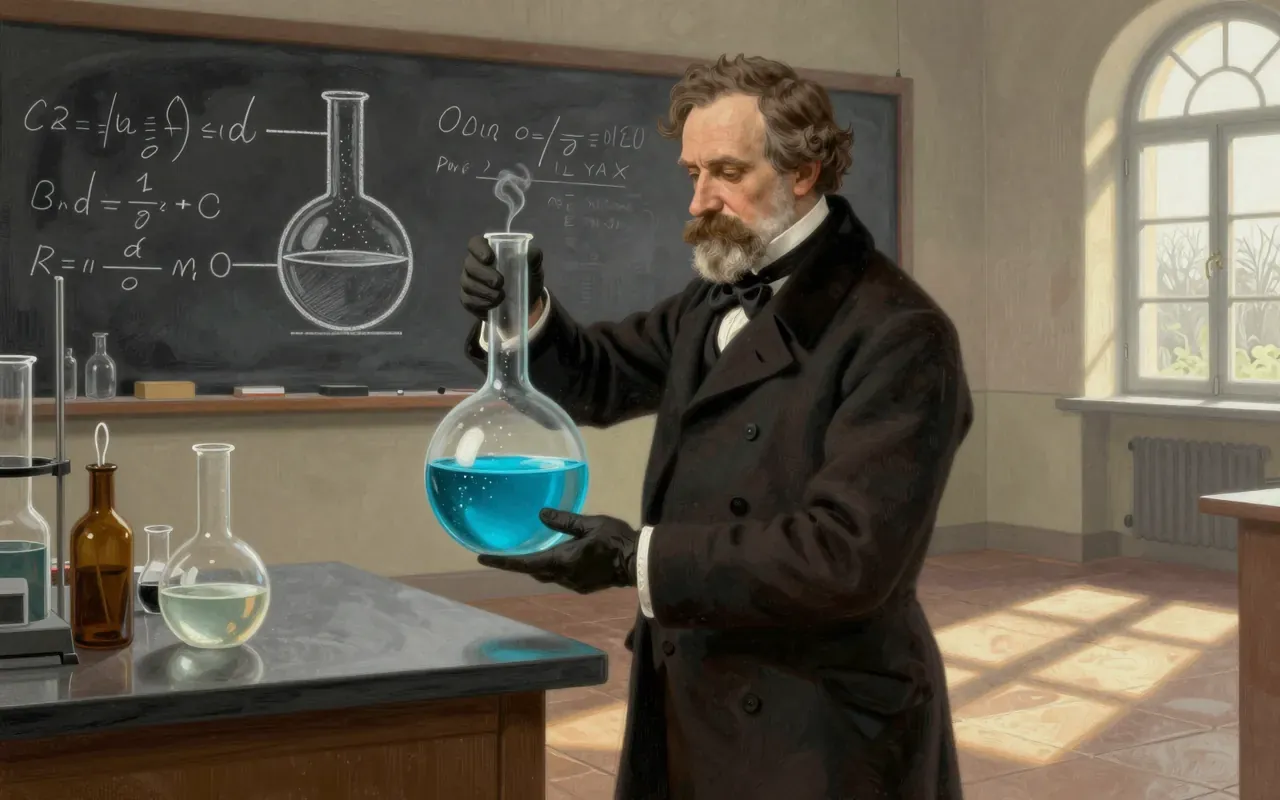
Pasteur’s answer, developed around 1859, was a flask built with an unusually long, narrow neck bent into a curve resembling a swan’s neck rather than sealed shut. He boiled meat broth inside it to kill anything already present, then simply left the neck open to the surrounding air, allowing air to move freely in and out of the flask rather than cutting off that access the way Spallanzani’s sealed vessels had. The design was meant to directly separate two things that earlier experiments had left tangled together, air itself, and whatever particles that air happened to be carrying.
Air in, dust trapped
The bends in the neck did the separating: air could still pass through, but dust and airborne microbial particles settled out along the moist walls of the curved tube before they ever reached the broth at the bottom. Flasks prepared this way stayed clear of any microbial growth for long stretches of time despite having constant, unobstructed contact with ordinary air, which answered the ambiguity Spallanzani’s work had left unresolved: growth had never depended on air itself, only on the particles air happened to be carrying into a vessel. Pasteur then showed the other side of the same result by tilting the flask, or breaking off the curved section of the neck, so that particles trapped in the bend could finally fall down into the broth.
Break the neck, and it spoils
Once that happened, the previously clear broth clouded with visible microbial growth within a short time, turning the same flask into its own before-and-after comparison without needing a separate control vessel at all. That pairing, sterile broth with an open but curved neck, contaminated broth once the curve was broken, is what made the result so difficult to argue with on its own terms: both conditions used identical broth, identical boiling, and identical exposure to air, differing only in whether particles could physically reach the liquid. It offered a clean mechanical answer to a dispute that had previously been argued largely in the abstract.
Not quite unanimous
The experiment is widely described as having settled the spontaneous generation question, though that verdict was not entirely unanimous; a minority of objections persisted afterward, and the practical business of sterilising glassware, controlling contamination, and reproducing the result reliably was considerably harder than the tidy popular version of the story tends to suggest. The French Academy of Sciences had offered a prize in 1862 for definitive experimental work on the question, and Pasteur’s flasks are generally credited with having answered it. He used the occasion to promote the idea of biogenesis, life arising only from existing life, a position that aligned with the pathologist Rudolf Virchow’s contemporaneous view that all cells arise only from prior cells.
From flask to germ theory
Together, these ideas helped cement both cell theory and the germ theory of disease, carrying a debate that had started with maggots on meat all the way to the recognition that specific microorganisms, not decaying matter on its own, drive fermentation and infection. The story is worth an hour for how directly a simple physical shape, a curved glass neck, converts a question that sounds almost philosophical into something anyone can watch happen or not happen. It is also a useful reminder that even a famous, elegantly designed result took real, unglamorous effort to carry out reliably, and did not convince every last sceptic on the day it was announced.