8:46in productionCh. 1 · The Step/ 8:46 · ceiling 15 min
Natural sciences · Evolution
Howard Carter
One tomb. One cartouche. Five thousand objects. Not proof — but proof enough to reset Egyptology.
Howard Carter’s discovery of Tutankhamun’s tomb was an act of meticulous fieldwork, not theoretical insight. It delivered unparalleled material density — over 5,000 objects in situ — but no new chronology, no revised dynasty map, no deciphered doctrine. Its power lies in singularity: one intact tomb, one confirmed identity, one fixed horizon for interpreting everything else.
The discovery began with a single step — literally — uncovered by a worker, then methodically excavated by Carter.
1:55
The Seal
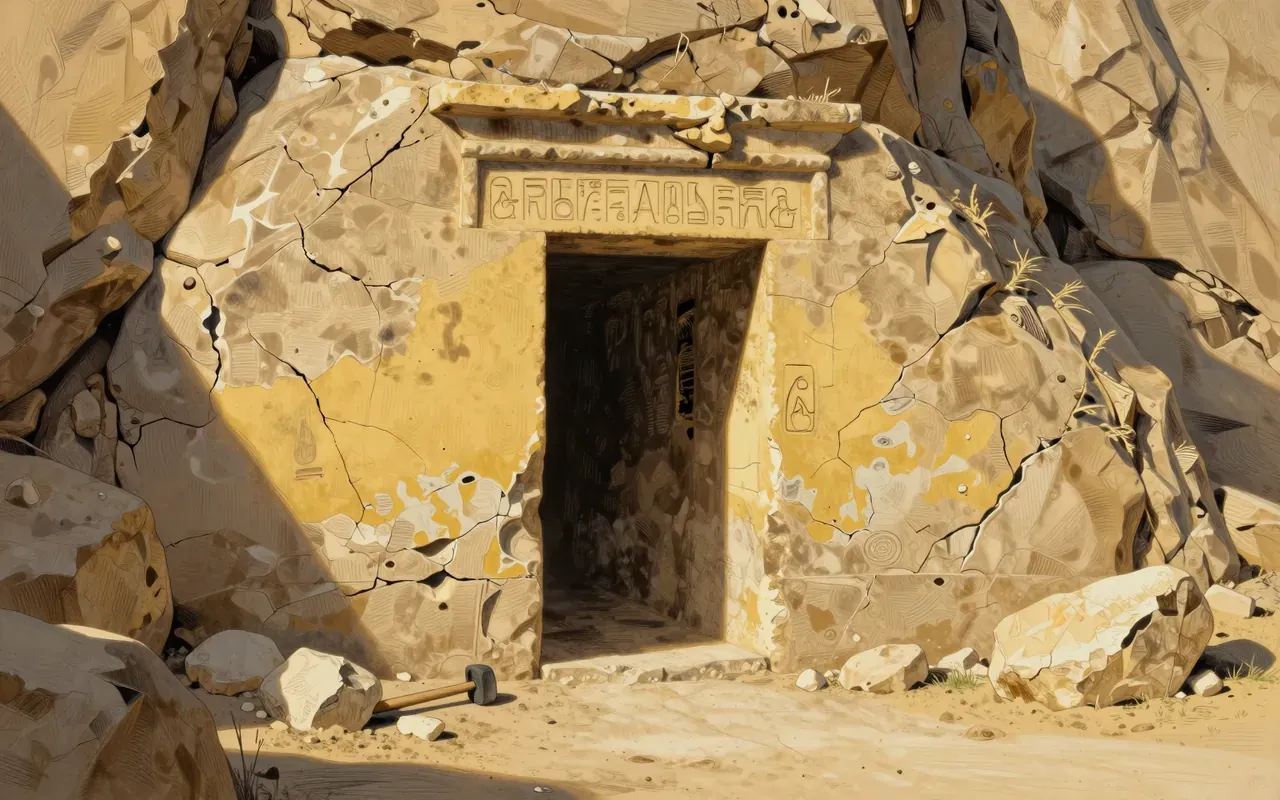
The cartouche seal confirmed identity before entry — archaeology’s first definitive attribution by inscription at the threshold.
3:02
The Breach
Carter used a personal chisel to make a breach, then saw gold and ebony treasures still in place — visual confirmation, not inference.
3:56
The Inventory
The tomb was designated KV62 and held over 5,000 items — the largest, most complete assemblage ever recovered from a pharaonic burial.
5:17
The Exception
This was the only intact pharaonic tomb ever found — a statistical outlier, not a representative sample.
Worth your time?
Yes. Study the whole thing.
4.5/ 5
What works
provides definitive burial context for one pharaoh
delivers largest known assemblage of New Kingdom funerary goods
confirms tomb attribution via cartouche seal before entry
enables typological anchoring for thousands of related artefacts
What does not
establish Tutankhamun’s political importance
refute prior theories about tomb robbery patterns
provide new linguistic or theological data
represent a typical New Kingdom burial
Study it if
historians of material culture
curators
conservators
Skip it if
geneticists
linguists
climate historians
The written brief1 min read
What the work claims
That the tomb belonged to Tutankhamun and remained functionally intact after millennia — a claim verified by the cartouche seal, the breach observation, and the subsequent inventory.
How it was done
A worker uncovered a step in the rock on 4 November 1922. Carter had the steps partially dug out until the top of a mud-plastered doorway was found. On 24 November, a seal with Tutankhamun’s cartouche was found on that doorway. On 26 November, Carter made a tiny breach in the top left-hand corner using a chisel given to him for his 17th birthday.
What holds up
Carter discovered Tutankhamun’s tomb (KV62) in November 1922. It was virtually intact. It contained over 5,000 items. A seal bearing Tutankhamun’s cartouche was found on the outer doorway. Carter confirmed contents visually through a breach, seeing gold and ebony treasures still in place.
What does not
The tomb was not untouched: it showed evidence of ancient break-ins. The discovery did not prove Tutankhamun’s historical significance — it revealed his burial context. It established no chronology, no genealogy, no theology, and no political narrative beyond what the objects themselves implied.
Why it matters beyond the lab
It matters because it anchored Egyptian material culture in a single, datable, unambiguous context — transforming museum collections from isolated artefacts into a coherent assemblage. It did not rewrite history; it gave history a fixed point of reference.
Is it worth your time
Yes — it is the only pharaonic tomb found virtually intact, containing over 5,000 objects. Its discovery reshaped Egyptology not through theory but through sheer material density and preservation.