A compass needle frozen into rock
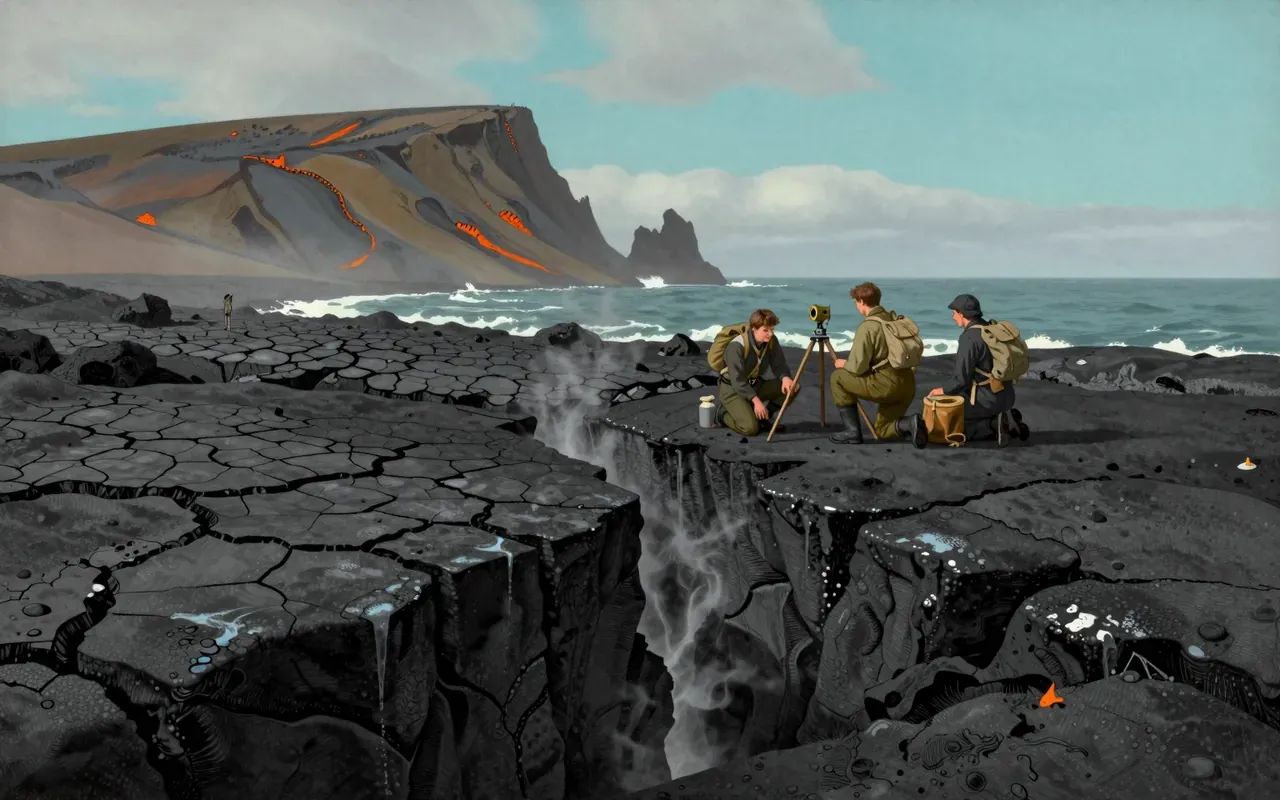
Magnetostratigraphy works because rock itself can record which way Earth’s magnetic field pointed at the moment the rock formed. Volcanic rock acquires this record as it cools, with magnetic minerals inside locking into alignment with the ambient field as the rock solidifies, a process called thermoremanent magnetisation. Sedimentary rock records the same information differently: fine magnetic grains settling out of water tend to orient themselves with the surrounding magnetic field before the sediment compacts, particularly in fine-grained rock types such as mudstone and claystone. Either way, the resulting rock preserves a directional fingerprint of Earth’s field at that specific point in time, and researchers extract this signal by measuring a sample’s remanent magnetisation after stripping away weaker, more recently acquired magnetic overprints through controlled demagnetisation.
Black and white bands that confirmed a theory
Once measured, these directional readings get organised into a sequence, plotted against depth in a rock formation to build a distinctive black-and-white column, black representing normal polarity, matching today’s field direction, and white representing reversed polarity, when the field pointed the opposite way. Matching a local column against the established Global Magnetic Polarity Time Scale, itself anchored using independently dated volcanic ash layers and fossil evidence, lets researchers assign specific ages to a rock sequence even where other dating methods are unavailable. This technique proved decisive in the 1960s, when Frederick Vine and Drummond Matthews recognised that parallel magnetic stripes recorded on the ocean floor matched this same normal-reversed pattern, providing the evidence that validated the theory of seafloor spreading and, with it, plate tectonics more broadly.
Reversals that arrive on no fixed schedule
Turning to the reversals themselves, the material states that at least 183 have occurred over the last 83 million years, working out to an average of roughly one every 450,000 years, though that average conceals enormous irregularity. Around 72 million years ago the field reversed as often as five times within a single million-year span, while other stretches of geological time passed for tens of millions of years without any reversal occurring at all. The most recent major reversal, known as Brunhes-Matuyama, occurred approximately 780,000 years ago, and estimates of how long the actual transition took vary considerably across different studies, with one 2019 study putting the duration at around 22,000 years, a genuinely long stretch during which the field would have been in a weakened, unstable transitional state rather than switching instantly.
The reversal beneath our own feet
The underlying mechanism is described as originating deep within the planet rather than from any external influence. Earth’s magnetic field is generated by a geodynamo, in which convection of molten iron within the planet’s core generates electric currents that in turn produce the magnetic field itself. Computer simulations run by Gary Glatzmaier and Paul Roberts reproduced reversals spontaneously from this dynamo mechanism alone, without needing to introduce any outside trigger, evidence that reversals are an inherent, self-generated feature of how the core operates rather than something imposed from outside the planet. The material notes that some scientists have proposed external triggers such as impact events, but states plainly that such mechanisms do not hold up well in quantitative modelling, leaving the internally generated explanation the better-supported one.
A magnetic engine running in the core
Not every disturbance to the field counts as a full reversal. The material distinguishes extended periods of unusual stability, called superchrons, including the Cretaceous Normal Superchron lasting some 37 million years and the Kiaman Reverse Superchron persisting more than 50 million years, from brief, weaker disturbances called excursions, which last only centuries rather than the thousands of years a full reversal transition takes. The Laschamp excursion, roughly 41,000 years ago, saw field strength drop to an estimated five percent of normal without the field actually completing a full reversal, and the material suggests these events may represent failed reversals, instances where the fluid outer core briefly flips polarity while the solid inner core does not follow, leaving the reversal incomplete and the field eventually snapping back to its original orientation.
Not always a full reversal
On consequences, the material is careful not to overstate the danger. While a weakened field during a reversal could in principle allow more high-energy particles trapped in the Van Allen belts to reach Earth, palaeomagnetic evidence indicates the field has never fully disappeared during a reversal, retaining meaningful strength even during the Brunhes-Matuyama transition. Most tellingly, the material states directly that statistical analysis shows no correlation between geomagnetic reversals and mass extinctions, a finding worth taking at face value rather than assuming a dramatic, catastrophic link that the evidence does not support. This is a solid, well-grounded hour for anyone wanting the actual mechanics behind both how geologists read rock as a magnetic archive and what is and is not known about why that archive keeps flipping.