Egg-sized rocks built in layers
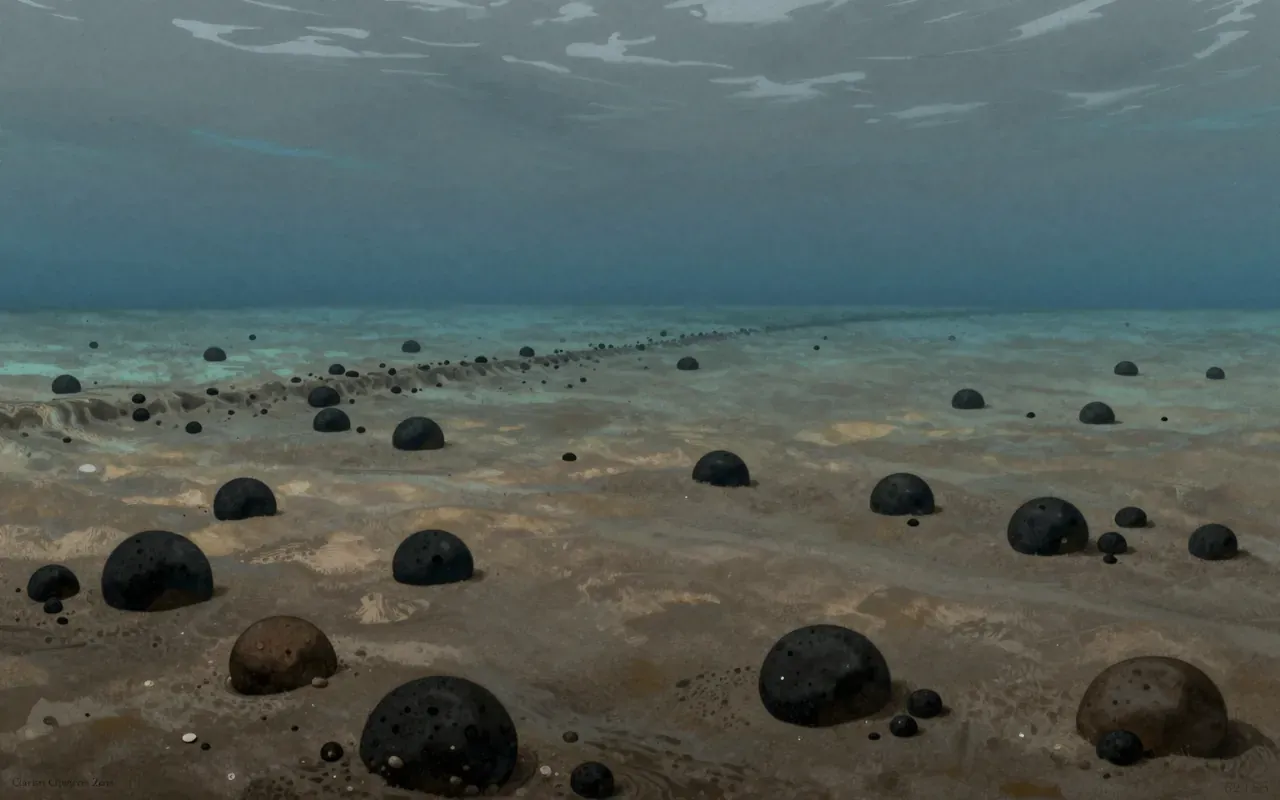
Manganese nodules are potato- or egg-sized mineral formations that lie scattered across parts of the deep ocean floor, typically measuring 3 to 10 centimetres across, though some grow larger than 20 centimetres. Each nodule builds up in concentric layers of iron and manganese hydroxides around a small core, which can be a fragment of shell, a shark’s tooth, or another small hard object that gives the growing layers something to accumulate around. Two distinct processes drive that growth: hydrogenetic formation draws metal directly from the seawater surrounding the nodule, while diagenetic formation draws metal from the water held within the surrounding sediment, and nodules can incorporate both processes over their lifetime depending on their specific location and depth.
Millimetres per million years
Whichever process dominates, the pace of growth is extraordinarily slow, among the slowest of any known geological phenomenon. Hydrogenetic nodule growth proceeds at roughly 2 to 5 millimetres per million years, while diagenetic growth is somewhat faster at around 10 millimetres per million years, meaning that a nodule several centimetres across has typically been accumulating material for a span of geological time measured in millions of years rather than anything resembling a human timescale. This growth rate matters directly for how the resource should be understood: whatever tonnage of nodules currently sits on the seafloor is effectively a fixed inventory rather than a renewable resource that will replenish itself on any timeframe relevant to mining operations.
21 billion tonnes between Hawaii and Mexico
The largest known concentration of these nodules lies in the Clarion-Clipperton Zone, a region of the Pacific Ocean floor between Hawaii and Mexico spanning roughly 4 million square kilometres at depths of 4,000 to 6,000 metres, estimated to hold about 21 billion tonnes of nodules in total. Their composition is what makes them commercially significant: a typical nodule is roughly 27 to 30 percent manganese by weight, with meaningful additional concentrations of nickel at around 1.25 to 1.5 percent, copper at roughly 1 to 1.4 percent, and cobalt at approximately 0.2 to 0.25 percent, alongside iron, silicon, aluminium, and various trace elements. That specific combination of metals overlaps considerably with what is needed for batteries and electronics, and the global seafloor is estimated to hold roughly 120 million tonnes of cobalt, about five times known terrestrial reserves of the metal.
Manganese, nickel, copper, and cobalt in one rock
Despite that resource scale, actual extraction remains at an early, exploratory stage rather than an established industry. The International Seabed Authority, established under the UN Convention on the Law of the Sea to govern mineral activities in international waters, had granted 31 exploration licences as of June 2025, covering 19 for polymetallic nodules, 7 for polymetallic sulfides, and 5 for cobalt-rich crusts, but no commercial-scale mining operation had yet commenced under any of them. One early commercial attempt, Papua New Guinea’s approved Solwara 1 project, was ultimately abandoned after the company behind it, Nautilus Minerals, filed for bankruptcy in 2019, illustrating that the gap between exploration licensing and viable commercial operation has proven substantial in practice.
Licences without commercial mines
The environmental case against proceeding quickly rests on specific evidence rather than general precaution. Mining techniques that stir up sediment plumes in the water column have been shown to trigger ecosystem impacts extending well beyond the immediate area disturbed, and a meta-analysis examining past seafloor disturbances found that most affected ecosystems had still not returned to their pre-disturbance condition even 26 years after the original disruption occurred, a finding that stands in stark contrast to the multi-million-year timescale over which the nodules themselves formed in the first place. That mismatch between how slowly the resource accumulates, how long recovery from disturbance appears to take, and how quickly commercial mining could in principle extract it is the central tension shaping the current international regulatory debate.
Ecosystems that don’t bounce back
This is a worthwhile read for the specific, quantified picture it gives of a resource most people have heard mentioned in passing, batteries need cobalt and nickel, the ocean floor has some, without understanding the actual scale, formation timescale, or regulatory status involved. The 26-year recovery finding in particular deserves attention because it is a concrete data point in a debate that often proceeds on assumption rather than evidence in either direction. Readers following supply chain and clean energy mineral debates, or simply curious how a resource that took millions of years to form is being weighed against metals demand measured in years, will find this a genuinely useful grounding in the specifics.