What the work claims
That electric current produces a detectable, directional mechanical effect on magnetic bodies — and that this effect can be amplified, stabilised, and rendered quantitatively responsive through geometric and material design.
How it was done
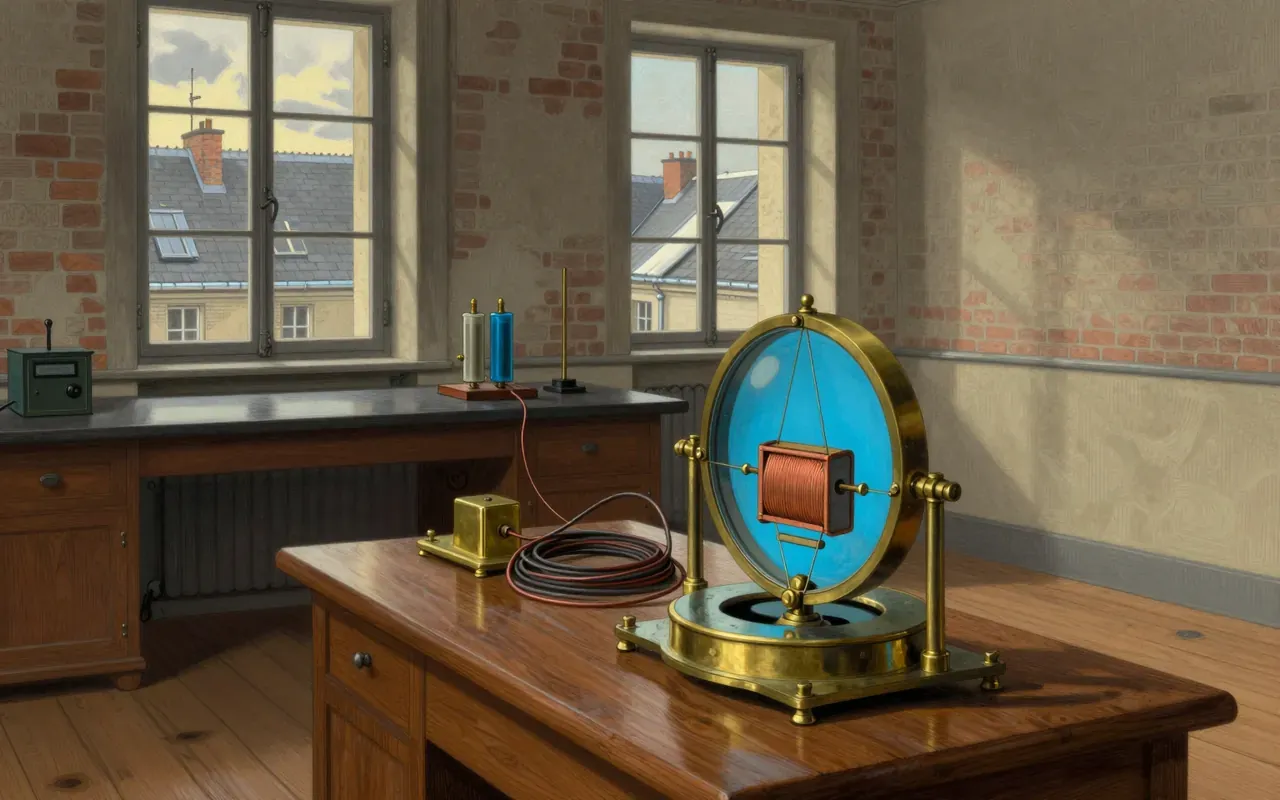
Ørsted observed compass needle deflection near a current-carrying wire in 1820. Schweigger built the first galvanometer at the University of Halle on 16 September 1820 using multiple wire turns to amplify magnetic effects. Ampère contributed to its development. Poggendorff invented a mirror galvanometer in 1826. Helmholtz invented an astatic version in 1849. Thomson patented a mirror galvanometer in 1858 that used a lightweight mirror suspended by a thread with small magnets to detect rapid current changes. D’Arsonval and Deprez introduced the moving-coil design in 1882, with a stationary permanent magnet and a coil suspended by fine wires that provided both electrical connection and restoring torque.
What holds up
The causal link between current and magnetic deflection holds. Multiple independent designs — Schweigger’s multiplier, Poggendorff’s mirror, Thomson’s thread-suspended mirror, D’Arsonval’s moving coil — all rely on and confirm Ørsted’s 1820 observation. Each refinement improved sensitivity or response time, but none contradicted the core electromagnetic coupling.
What does not
It does not measure current magnitude in absolute units. Early versions gave only relative deflection. No source states calibration, standardisation, or SI traceability. It does not detect current without magnetic interaction. It does not work in zero-field environments or with non-magnetic conductors alone.
Why it matters beyond the lab
It enabled telegraphy, submarine cable signalling, early power grid monitoring, and laboratory instrumentation for electromagnetism. Without it, Maxwell’s equations would have lacked empirical anchoring in real-time measurement. It turned electricity from a curiosity into an engineering variable.
Is it worth your time
Yes — it is the foundational instrument for quantitative electrodynamics. Its evolution maps the shift from qualitative observation to precision measurement in physics. You need to understand it to grasp how electricity became measurable, controllable, and ultimately engineered.