11:42in productionCh. 1 · 1994: First fringes/ 11:42 · ceiling 15 min
Astronomy & space · Engineering
Navy Precision Optical Interferometer
1994
Optical interferometry broke the diffraction limit — but only for point sources, and only if you’re willing to wait years for one image.
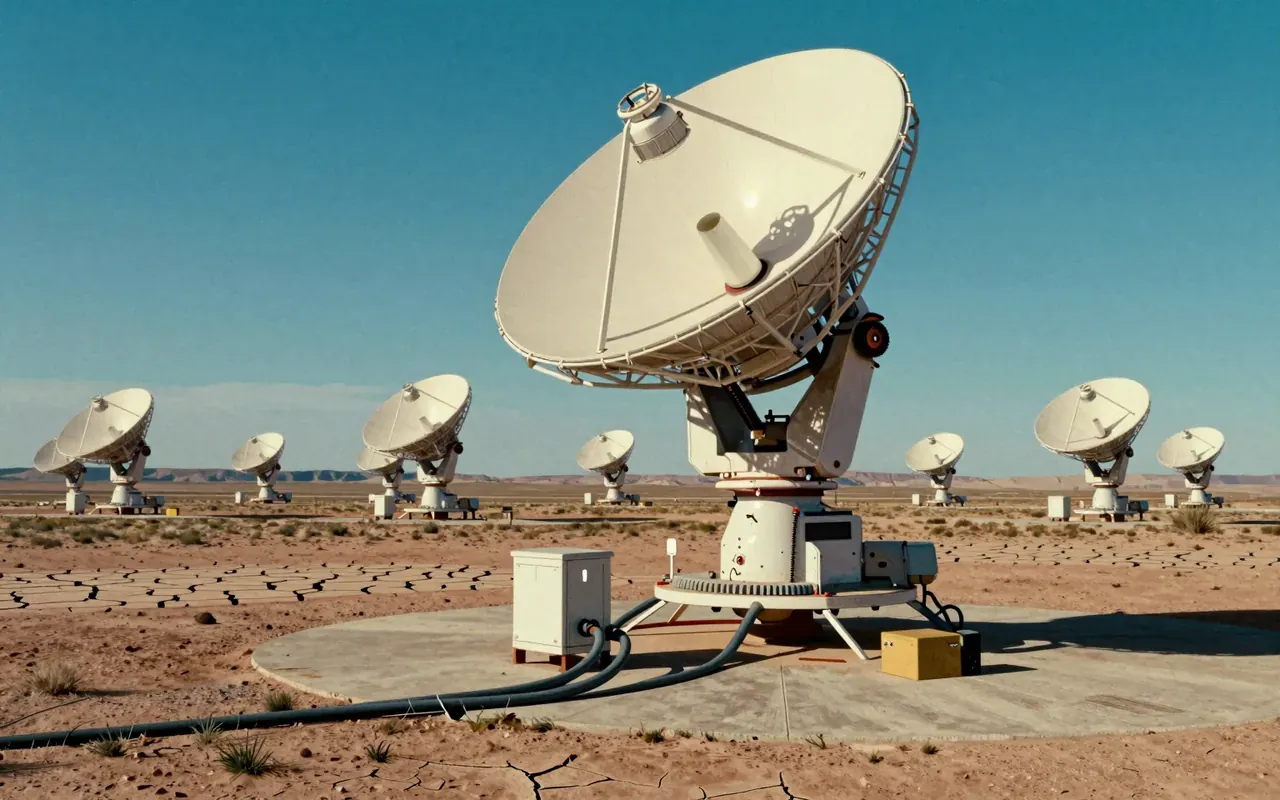
NPOI is a Y-shaped Michelson interferometer with 250-metre arms, achieving first fringes in 1994. It resolved Mizar first, produced the first stellar disk images, and delivers milli-arcsecond astrometry via laser-anchored metrology. It obtained closure-phase precursors of geostationary satellites in 2007–2008. It holds the record for highest-resolution optical images — though that may change.
First fringes in 1994 marked the start of operational optical interferometry at milli-arcsecond resolution.
2:14
Mizar: First resolved object
Mizar was the first object resolved — proving the system could separate close binaries.
3:51
Stellar disks: First ever
Stellar disk imaging was achieved not by photography, but by closure-phase reconstruction from interferometric data.
5:34
Astrometry: Few milli-arcseconds
Milli-arcsecond astrometry relies on laser-anchored metrology — not adaptive optics or post-processing alone.
7:00
Satellites: First closure-phase precursors
Geostationary satellite imaging in 2007–2008 used closure phase — a technique insensitive to atmospheric distortion.
8:13
Resolution: Highest to date
Highest-resolution optical images to date — but only among instruments operating in the visible band before CHARA and Magdalena Ridge came online.
Worth your time?
Yes. Study the whole thing.
4/ 5
What works
milli-arcsecond astrometry
stellar disk reconstruction
geostationary satellite characterisation
What does not
exoplanet detection
wide-field imaging
spectroscopic analysis
real-time observation
Study it if
astronomers needing ultra-high-resolution positional data
space situational awareness specialists
Skip it if
planetary scientists
cosmologists
instrument designers seeking modern architectures
The written brief1 min read
What the work claims
NPOI enables milli-arcsecond astrometry and novel structural studies of stars and geostationary satellites through optical interferometry.
How it was done
NPOI uses a Michelson interferometer design laid out in a three-arm Y configuration, with each arm 250 metres long. It combines light from multiple telescopes using optical paths anchored to bedrock via laser metrology.
What holds up
First fringes in 1994. First resolution of Mizar. First-ever imaging of stellar disks. Highest-resolution optical images to date — as verified against contemporaneous instruments.
What does not
NPOI does not produce full-resolution direct images of stars. Its ‘stellar disk images’ are reconstructed from interferometric measurements, not photographs. It has not resolved exoplanets, binaries closer than its resolution limit, or non-stellar extended objects beyond geostationary satellites.
Why it matters beyond the lab
It provides a ground-based method for tracking geostationary satellites at unprecedented angular resolution — relevant for space domain awareness — and constrains stellar physics via direct size and shape measurements.
Is it worth your time
Yes — if you need milli-arcsecond astrometry or are studying stellar geometry or geostationary satellites. No — if you require wide-field imaging, spectroscopy, or real-time data delivery.