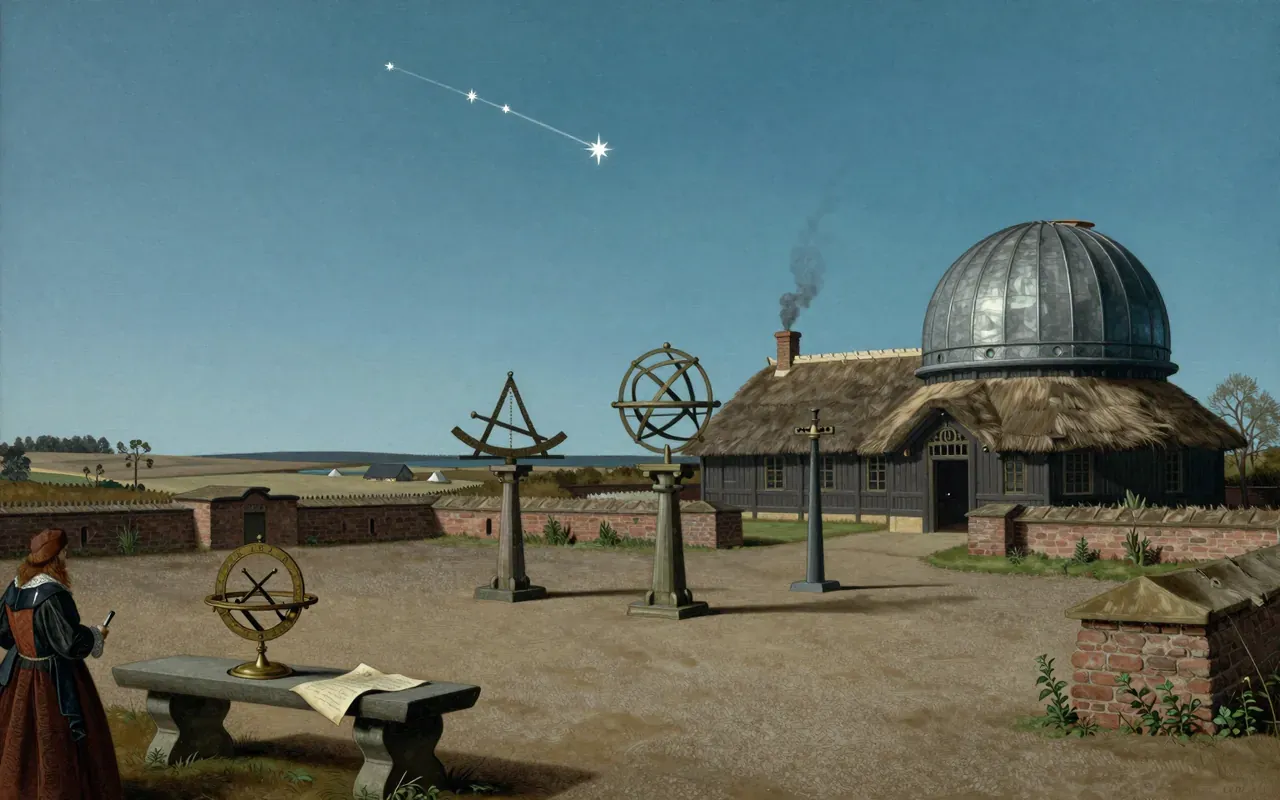
A new star in Cassiopeia
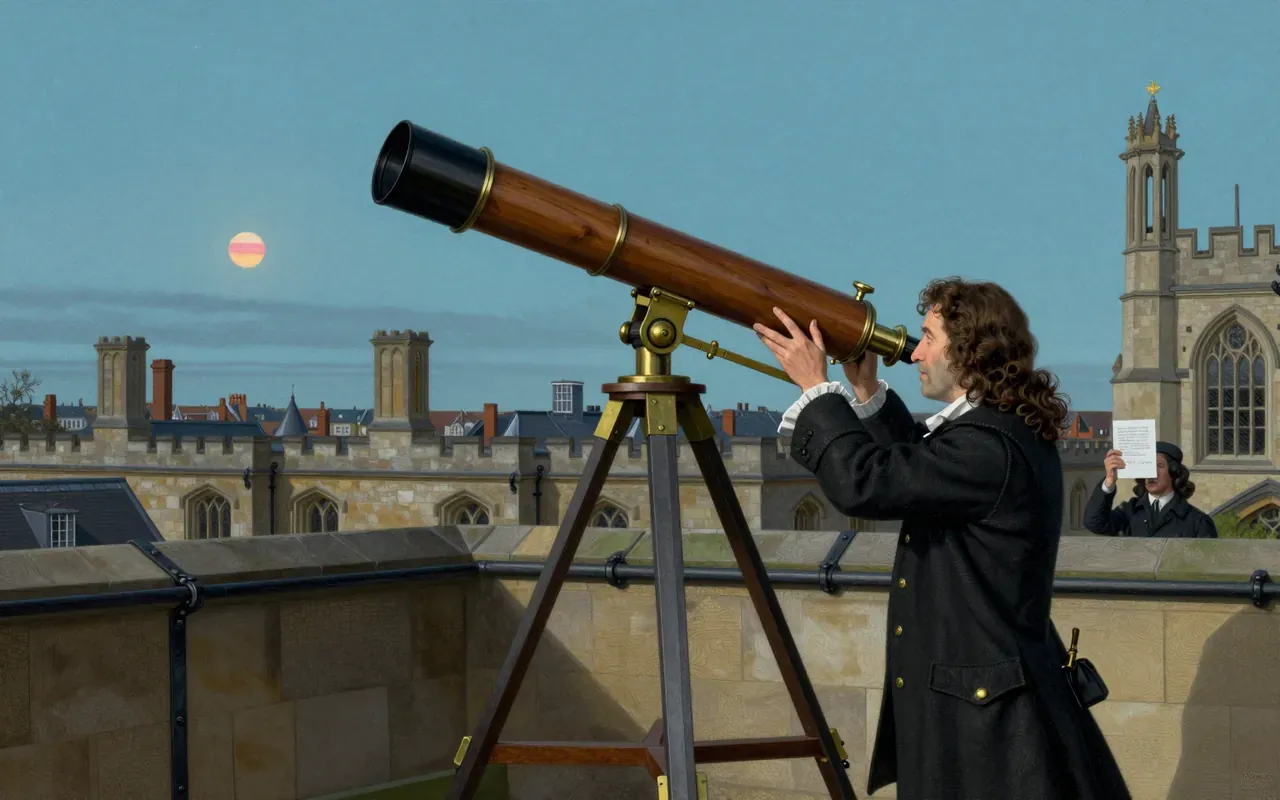
In early November 1572 a new point of light appeared in the constellation Cassiopeia, noticed independently by observers across Europe, among them Tycho Brahe, Jerónimo Muñoz, Christopher Clavius, Thomas Digges and John Dee. By 11 November it had already outshone Jupiter, and it reached its peak around 16 November at a brightness comparable to Venus, before fading slowly and remaining visible to the naked eye into early 1574. Brahe wrote up his observations as De nova et nullius aevi memoria prius visa stella, published in 1573, coining the word nova for an object of this kind. The star he described is now catalogued as SN 1572, one of only a handful of supernovae bright enough to have been recorded by the naked eye in history.
No parallax, no nearby explanation
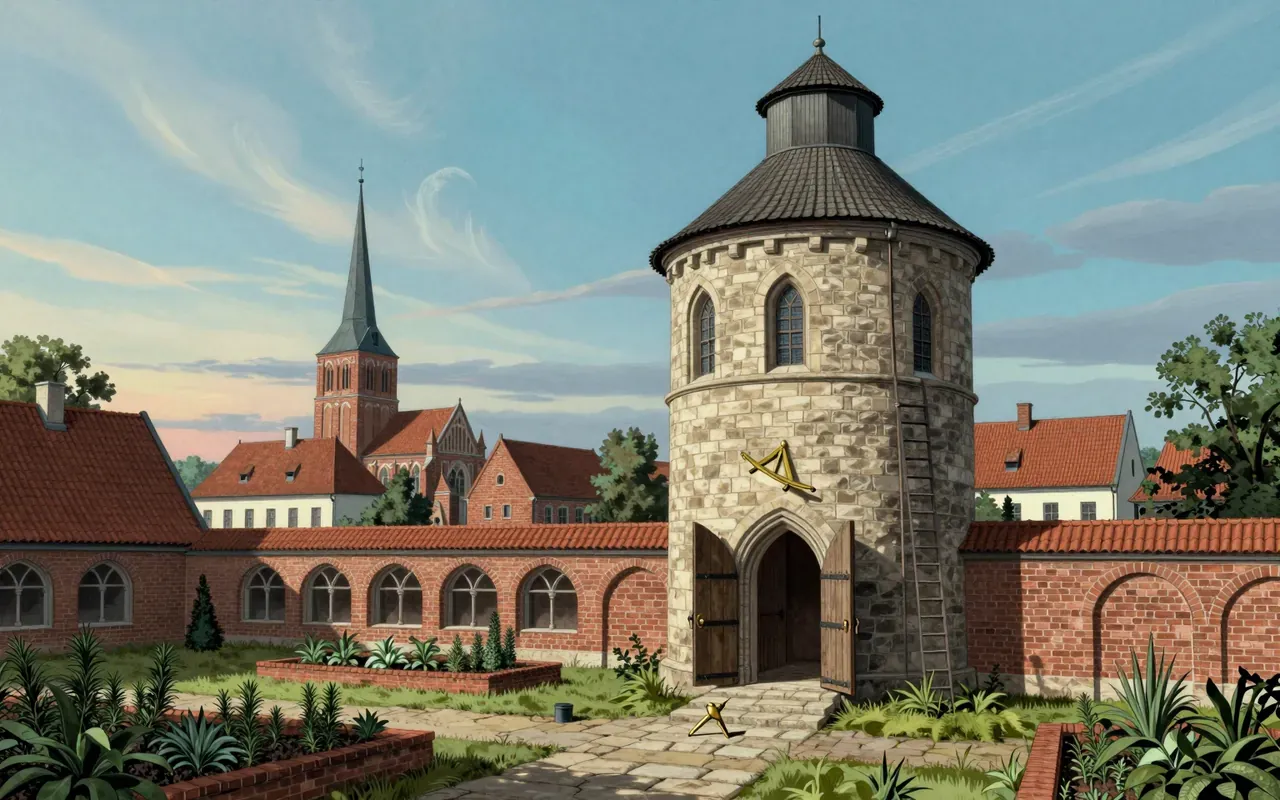
Brahe’s case rested on a specific, checkable measurement: parallax, the small apparent shift in position that a nearby object shows against distant background stars when viewed from different points, such as opposite sides of the Earth’s daily rotation. Using sextants and quadrants he had built and refined, with recorded accuracy ranging between roughly 32 and 49 arcseconds depending on the instrument, and mounting some of them underground to cut down on vibration, he tracked the new star’s position night after night and compared his results with those of the Spanish astronomer Jerónimo Muñoz. Anything within the Moon’s orbit should have shown a measurable shift. This object showed none, which meant it lay beyond the Moon, among the fixed stars rather than in the supposedly changeable air and fire below them.
A challenge to an unchanging sky
That core result has held up: the absence of a detectable daily parallax was a real, testable finding, not a matter of interpretation, and it placed the new star firmly outside the sublunary region where classical cosmology confined change and decay. Modern astronomy confirms the object was a genuine stellar explosion, now studied as SN 1572 and identified as a Type Ia supernova, the kind produced by a white dwarf star. The remnant has since been picked up independently at multiple wavelengths: first at radio frequencies in 1952 from Jodrell Bank Observatory, then in X-rays via the Uhuru satellite, and directly imaged in the visible as a faint nebula at Palomar Mountain Observatory in the 1960s, each confirming the same object Brahe had measured four centuries earlier.
What Tycho’s instruments could and could not tell him
What Brahe could not do was explain the object he had so carefully located. He could rule out an origin below the Moon, and he could conclude it belonged among the fixed stars, but the concept of a stellar explosion did not exist yet, so his triumph was negative: he showed what the new star was not, rather than what it was. Even in the modern record, some figures have moved with better instruments. The remnant’s shell was once measured expanding at around 9,000 kilometres a second, a figure later studies put below 5,000; and a candidate companion star, Tycho G, identified in 2004 with an unusually high velocity of 136 kilometres a second, had that velocity revised down to 56 kilometres a second once Gaia satellite data became available.
Four centuries of follow-up
The significance of Brahe’s result went well beyond one bright object in Cassiopeia. Aristotelian cosmology held that the celestial sphere was eternal and unchanging, with all alteration confined to the terrestrial region beneath the Moon; a new, unpredicted star appearing among the fixed stars was difficult to square with that picture. Brahe’s measurement did not by itself overturn the geocentric model he continued to work within, but it removed one of that model’s foundational assumptions and pushed astronomers of the period toward demanding better catalogues and sharper instruments, the same drive toward precision that later fed into Kepler’s use of Brahe’s own observational data. The episode is remembered as one of the moments that made the sky an object of ongoing measurement rather than settled doctrine.
Is it worth your time
This is a story built on one clean, repeatable measurement, which is what makes it hold up so well across nearly 450 years: a claim anyone with a good instrument could check, and one that modern radio, X-ray and optical astronomy have all independently confirmed by tracing the same remnant. It rewards attention less for the astrophysics of Type Ia supernovae, which the brief only sketches, than for watching how a single absence, no detectable parallax, did more damage to an entrenched cosmology than any amount of argument had managed. Readers who like seeing an old observation still being refined by satellite data centuries later, as with the companion star’s revised velocity, will find that thread satisfying too.