What the work claims
That Lucy is a bipedal hominin whose anatomy reflects both terrestrial locomotion and tree-climbing; that her diet was plant-based; that she belongs to a previously unrecognised species, Australopithecus afarensis; and that her discovery, alongside AL 333, provides evidence of group living in early hominins.
How it was done
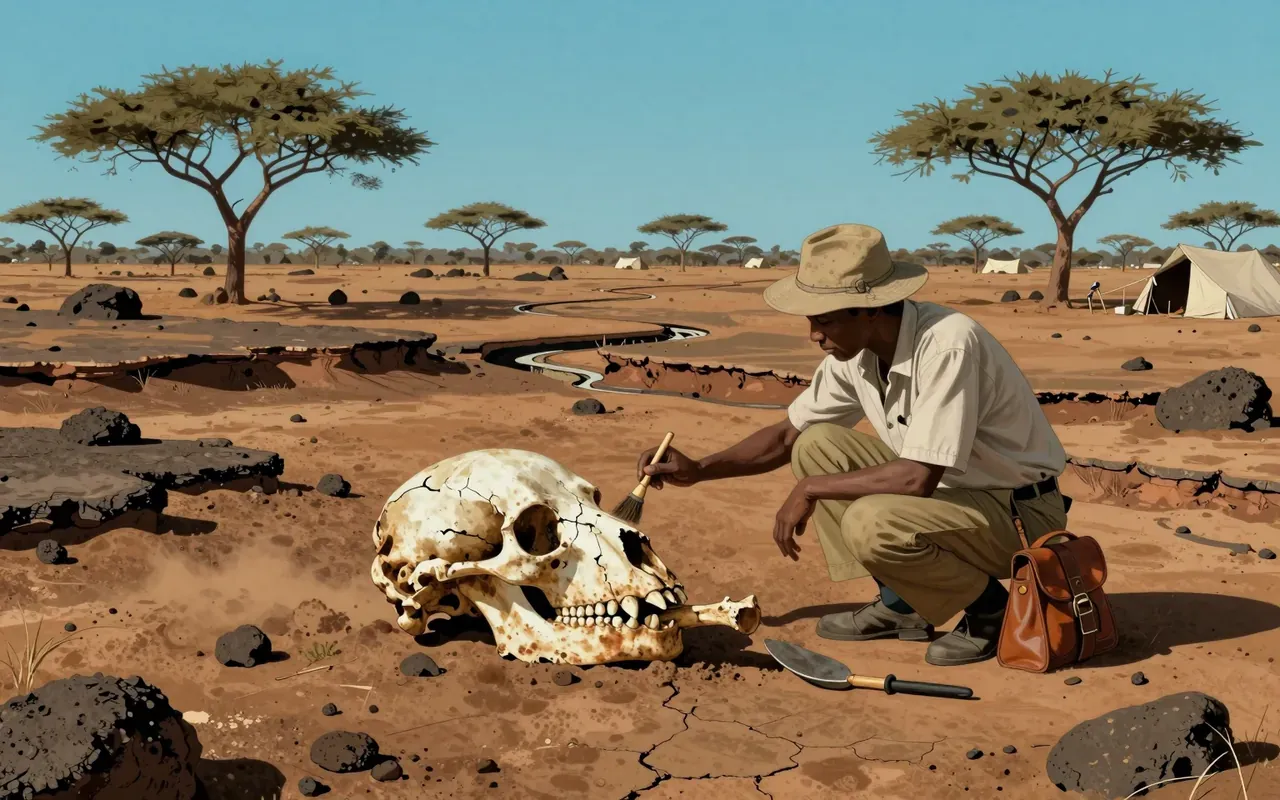
Johanson discovered Lucy during an impromptu survey in Hadar, Ethiopia, identifying a fossilised hominin bone by visual recognition. His team later recovered 40% of the skeleton. They discovered AL 333—the ‘First Family’—in Hadar in 1975, comprising teeth and bones from at least thirteen individuals.
What holds up
Lucy’s bipedalism supported Raymond Dart’s theory of upright walking in australopithecines. Her curved finger bones indicated arboreal capability. Her rib morphology led the team to conclude she ate a plant-based diet. Forty per cent of her skeleton was recovered and she became the first known member of A. afarensis—after reclassification.
What does not
Lucy was not initially classified as Australopithecus afarensis. That designation emerged only after later skull discoveries—not from Lucy alone. The claim that she ‘established’ A. afarensis as a species misattributes causality: it was the accumulation of skulls, not her skeleton, that persuaded palaeontologists.
Why it matters beyond the lab
It matters because Lucy anchored a new species in time and anatomy—and because AL 333 showed multiple individuals preserved together, raising testable questions about social structure. But the narrative of ‘the missing link’ or ‘our earliest ancestor’ is not claimed in the sources and must be excluded.
Is it worth your time
Yes—if you need to understand how a single visual identification reshaped human origins research. It is not about Lucy’s completeness or uniqueness, but about how one find catalysed species-level reclassification and field-wide methodological shifts.