What the work claims
That humans evolved in Africa, with deep antiquity confirmed by fossils and tools at Olduvai Gorge — and that humans reached North America before 100 ka, based on artefacts at Calico Hills.
How it was done
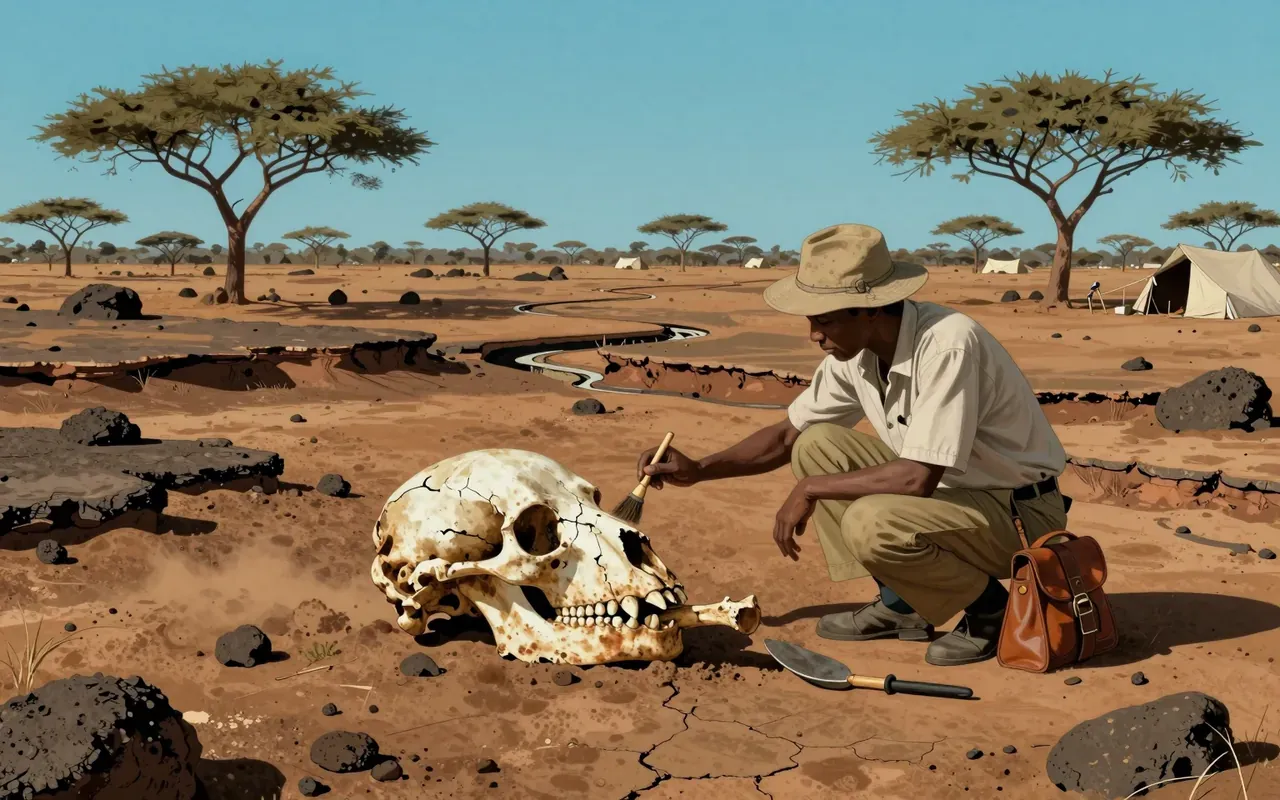
Leakey and his team excavated at Olduvai Gorge in Tanzania, using stratigraphic context and collaboration with geophysicists to date layers. Mary Leakey discovered OH 5 in 1959; Evernden and Curtis dated Bed I in 1960; Leakey, Philip Leakey and Ray Pickering found OH 9 the same year; Ndibo Mbuika found the first Homo habilis tooth at MNK in 1962. At Calico Hills in California, Leakey and Simpson excavated stone artefacts in 1963.
What holds up
Leakey’s work demonstrated human evolution in Africa. Bed I was dated to 1.89–1.75 Ma. Paranthropus boisei (OH 5) was discovered at FLK in 1959. Homo erectus (OH 9) was found in 1960 and dated to 1.4 Ma. Homo habilis’ first tooth was found at MNK in 1962. These are all verified claims grounded in excavation, stratigraphy and radiometric dating.
What does not
The Calico Hills claim — that stone artefacts there are >100 ka — is not supported by subsequent work. The material does not report consensus, replication or refutation, but no verified claim affirms its validity. Also, the material does not support attributing the Olduvai discoveries solely to Louis Leakey: Mary Leakey discovered OH 5; Ndibo Mbuika found the first Homo habilis tooth; Philip Leakey and Ray Pickering co-discovered OH 9.
Why it matters beyond the lab
It shifted palaeoanthropology from Eurocentric assumptions to an African origin framework — a foundational pivot. But the Calico Hills claim, though widely reported, remains isolated and uncorroborated in the material, exposing how single-site interpretations can outpace evidence.
Is it worth your time
Yes — it reoriented human origins research to Africa and established field methods still used today. But its Calico Hills claim has not held up, and attribution of discoveries to Leakey alone obscures Mary Leakey’s central role.