What the work claims
Mendel claimed that inheritance follows predictable, numerical rules governed by invisible ‘factors’ — one inherited from each parent — which retain identity across generations and determine traits in dominant or recessive form. He claimed these factors explain why certain traits disappear in one generation and reappear unchanged in the next.
How it was done
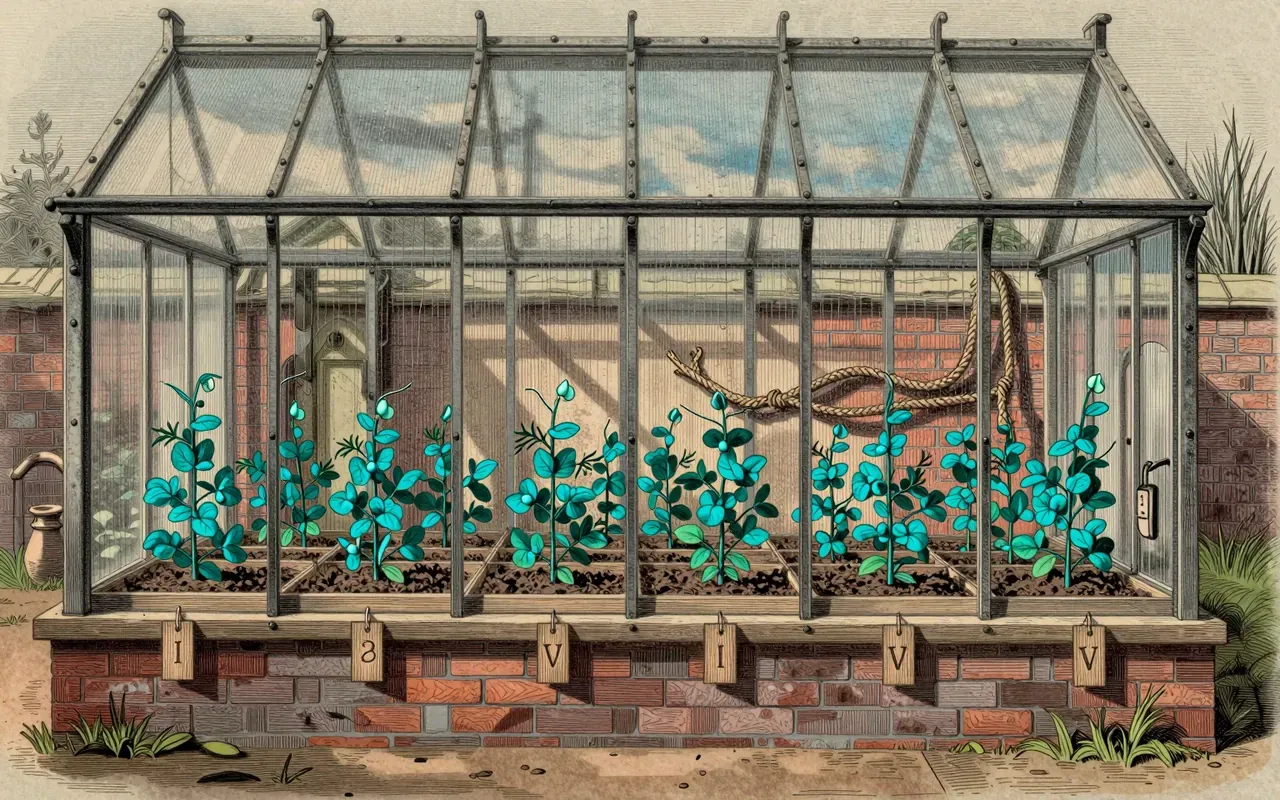
Mendel conducted controlled pea plant hybridization experiments between 1856 and 1863. He worked with seven specific traits: plant height, pod shape and colour, seed shape and colour, and flower position and colour. He cultivated and tested about 28,000 pea plants. He cross-bred true-breeding varieties and tracked trait expression across generations.
What holds up
The 3:1 F2 ratio for seed colour holds: true-breeding yellow × green crosses produced only yellow seeds in the first filial generation; green reappeared in the second generation at 1:3. The classification of traits as dominant or recessive, and the inference of discrete, non-blending hereditary ‘factors’, are empirically supported by his data and experimental design.
What does not
The work does not establish molecular mechanisms, evolutionary function, or exceptions to the ratios (e.g., linkage, epistasis, polygenic traits). It does not address variation outside pea plants, nor does it claim universality beyond the traits and species studied.
Why it matters beyond the lab
It matters because it replaced blending inheritance with particulate inheritance — a conceptual shift that made genetics possible as a science. Without this, no gene mapping, no CRISPR, no pedigree analysis, no understanding of genetic disease risk would have a logical starting point.
Is it worth your time
Yes. Mendel’s work is the empirical origin of genetics — not a theoretical speculation, but a quantitative, repeatable demonstration of inheritance patterns using controlled breeding, large sample sizes, and explicit ratios. It remains foundational for understanding heredity in all sexually reproducing organisms.