sciencebriefs
all subjects →
10:42in productionCh. 1 · Nine Cities, One Hill/ 10:42 · ceiling 15 min
Natural sciences · Evolution

Heinrich Schliemann

Schliemann didn’t find Troy — he buried it under his own certainty.

Schliemann’s excavation at Hisarlık revealed nine stratified cities and substantial Bronze Age material — but his trench method compromised stratigraphic integrity, and his attribution of the 'Burnt City' to Homeric Troy is invalidated by dating.

Chapters & takeaways4
  1. 0:59
    Nine Cities, One Hill

    Hisarlık contains nine superimposed cities — confirmed by modern research — spanning 3,600 years.

  2. 2:31
    Bronze at Depth

    At 28–29½ feet, Schliemann uncovered Bronze Age metalwork: copper, molds, tools, shields, and vases.

  3. 3:59
    The Last-Day Gold

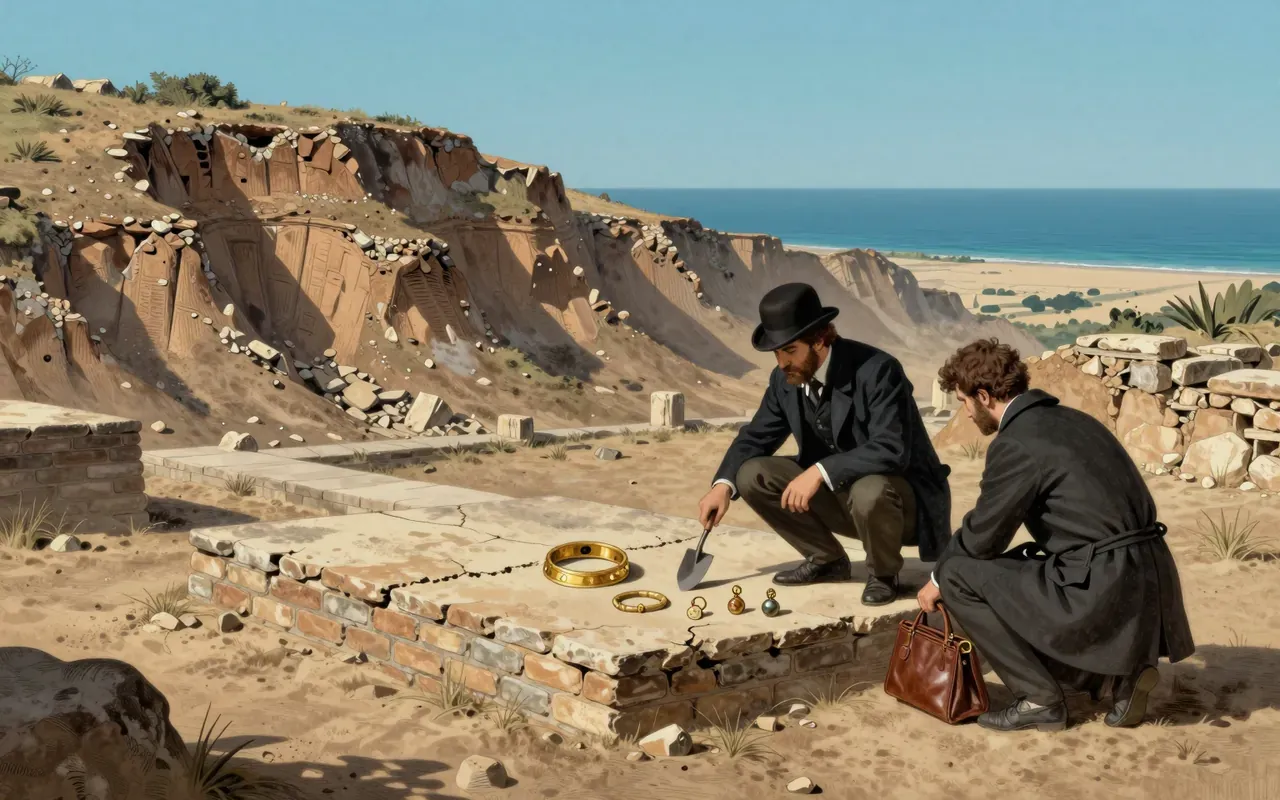
    On 15 June 1873, Schliemann unearthed gold he declared Priam’s Treasure — before digging was due to stop.

  4. 6:07
    The Burnt City Fallacy

    His trench method destroyed stratigraphic context — and the layer he named 'Troy' is now known to predate the Homeric war by a millennium.

Worth your time?

Yes. Study the whole thing.

3.5/ 5
What works
  • discovery of nine cities at Hisarlık
  • recovery of Bronze Age metalwork at depth
  • confirmation of long-term settlement at Hisarlık
What does not
  • Schliemann’s identification of the 'Burnt City' layer as Homeric Troy
Study it if
  • historians of science
  • archaeology students
  • critics of narrative-driven research
Skip it if
  • those seeking definitive proof of Homeric events
  • readers who assume early fieldwork meets modern standards
The written brief1 min read

What the work claims

Schliemann claimed to have found Homer’s Troy — specifically, Priam’s Treasure in the ‘Burnt City’ layer — validating the historicity of the Iliad.

How it was done

Schliemann excavated at Hisarlık using trench excavation. He performed soundings at Pınarbaşı to test its suitability as Troy’s site, but abandoned it after poor results.

What holds up

His discovery of nine buried cities at Hisarlık by 1873 holds. So does his recovery of Bronze Age material — pure copper, molds, tools, cutlery, shields, and vases — at 28–29½ feet depth. Recent research confirms multiple settlements spanning 3,600 years at the site.

What does not

Schliemann’s identification of the ‘Burnt City’ layer as Homeric Troy does not hold. It is now dated 3,000–2,000 BCE — too early for the Trojan War as described by Homer.

Why it matters beyond the lab

It matters because Schliemann’s work established archaeology as a tool for myth-testing — but also demonstrated how excavation without stratigraphic discipline can erase the very evidence needed to verify its own claims.

Is it worth your time

Yes — if you want to understand how foundational archaeological claims are built, then undermined, by method and dating. Not for what it proved, but for how it exposed the gap between narrative ambition and stratigraphic evidence.
Same field · Natural sciences4 of 10
Up next in Science

Henri Poincaré

· 11:05

Poincaré didn’t just anticipate relativity — he built its mathematical skeleton before Einstein published.

11:05