11:58in productionCh. 1 · What it was for/ 11:58 · ceiling 15 min
Engineering · Astronomy & space
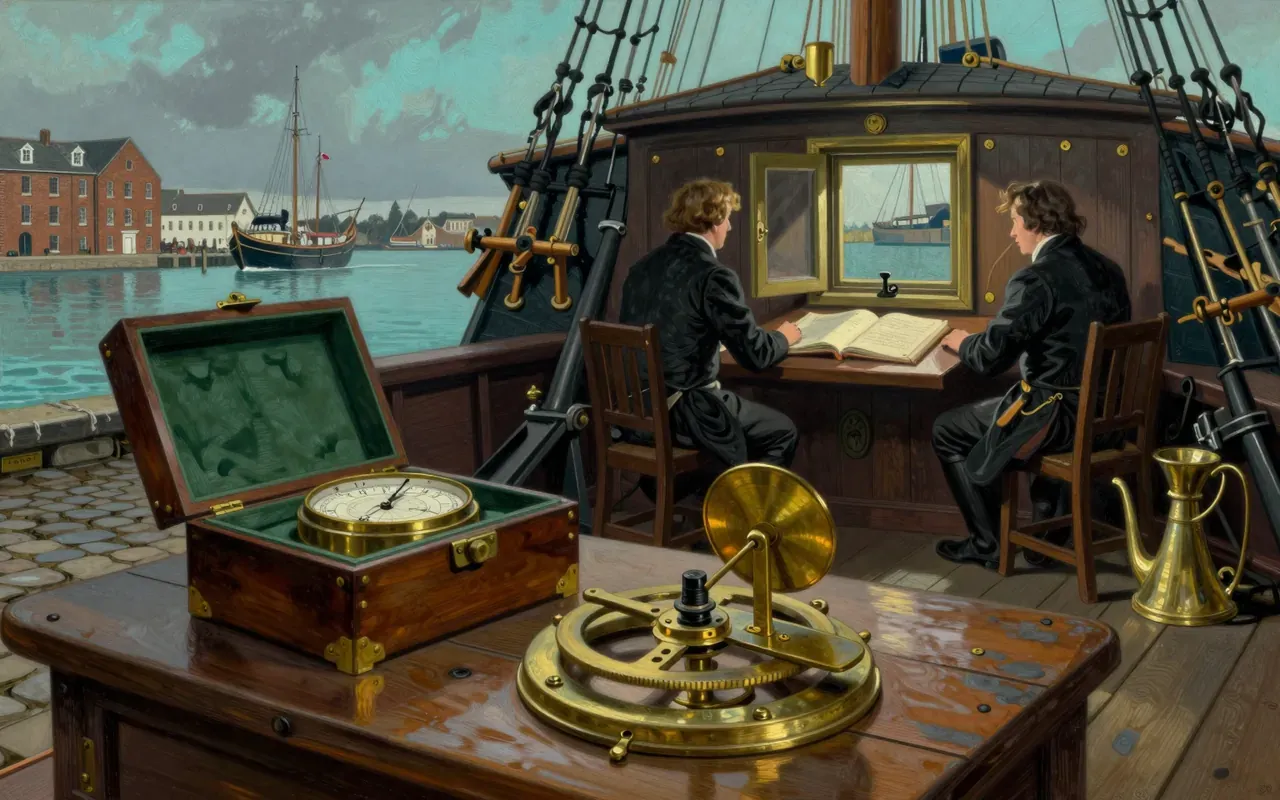
Marine chronometer
1736
The marine chronometer didn’t invent precision—it weaponised time against uncertainty.
The marine chronometer was not a 1736 invention. It emerged through iterative mechanical fixes—Harrison’s H4 (1761) and Le Roy’s 1766 design—to overcome pendulum failure at sea. Its function was narrow: keep Greenwich time aboard moving ships so longitude could be calculated from celestial observations. It succeeded only after 1767. Its legacy is engineering rigour—not elegance.
A marine chronometer measures Greenwich time at sea to calculate longitude—not by stars alone, but by time difference.
2:35
Why pendulums drowned
Pendulum clocks failed at sea because ship motion and gravity shifts broke their physics.
4:04
How stability was forged
Harrison’s H4 and Le Roy’s 1766 chronometer solved stability with balance wheels, bi-metallic strips, and detent escapements.
5:13
When it first worked
The first verified longitude measurement using a marine chronometer happened in 1767—not 1736—aboard Aurore.
6:57
How long it lasted
Harrison’s and Le Roy’s mechanical solutions defined marine timekeeping until electronic oscillators replaced them.
8:25
What time it kept
Its sole purpose was measuring the time of a known fixed location—not local time, not elapsed time, not rhythm.
Worth your time?
Yes. Study the whole thing.
4/ 5
What works
precision timekeeping at sea
longitude calculation via time difference
temperature compensation in mechanical systems
What does not
1736
invention
proof
breakthrough
Study it if
maritime historians
instrument designers
navigation educators
Skip it if
general science readers seeking foundational physics
astronomers studying celestial mechanics
The written brief1 min read
What the work claims
The marine chronometer claims to enable accurate longitude determination at sea by maintaining precise time from a known fixed location—Greenwich—despite motion and gravity variation.
How it was done
Marine chronometers used precision timekeeping aboard ships to compare Greenwich Mean Time with local time derived from celestial observations. Harrison’s H4 (1761) employed a fast-beating balance wheel and temperature-compensated spiral spring. Le Roy’s 1766 chronometer added the detent escapement, temperature-compensated balance, and isochronous balance spring.
What holds up
The chronometer established that portable, ship-stable timekeeping could fix longitude via time-difference arithmetic. Its core method—comparing GMT with local solar time—remained unchanged for two centuries. The bi-metallic strip, detent escapement, and temperature-compensated balance were all verified working components.
What does not
The marine chronometer did not solve longitude in 1736. No chronometer was successful before 1761 (Harrison’s H4), and the first verified longitude measurement using one occurred only in 1767 aboard Aurore. Claims of a functional marine chronometer in 1736 are unsupported.
Why it matters beyond the lab
It ended the era where ships vanished without trace. Accurate longitude reduced voyage times, cut losses from wreck and starvation, and enabled systematic cartography. It turned ocean navigation from art into repeatable engineering.
Is it worth your time
Yes—if you care how navigation moved from guesswork to reproducible measurement. It is not about timekeeping elegance; it is about eliminating a single fatal variable—longitude uncertainty—in maritime travel.

Francis William Aston never built a triple quadrupole mass spectrometer — and crediting him with it erases the real inventors and distorts how isotopes were actually discovered.