sciencebriefs
all subjects →
9:44in productionCh. 1 · A name before a standard/ 9:44 · ceiling 15 min
Engineering · Chemistry

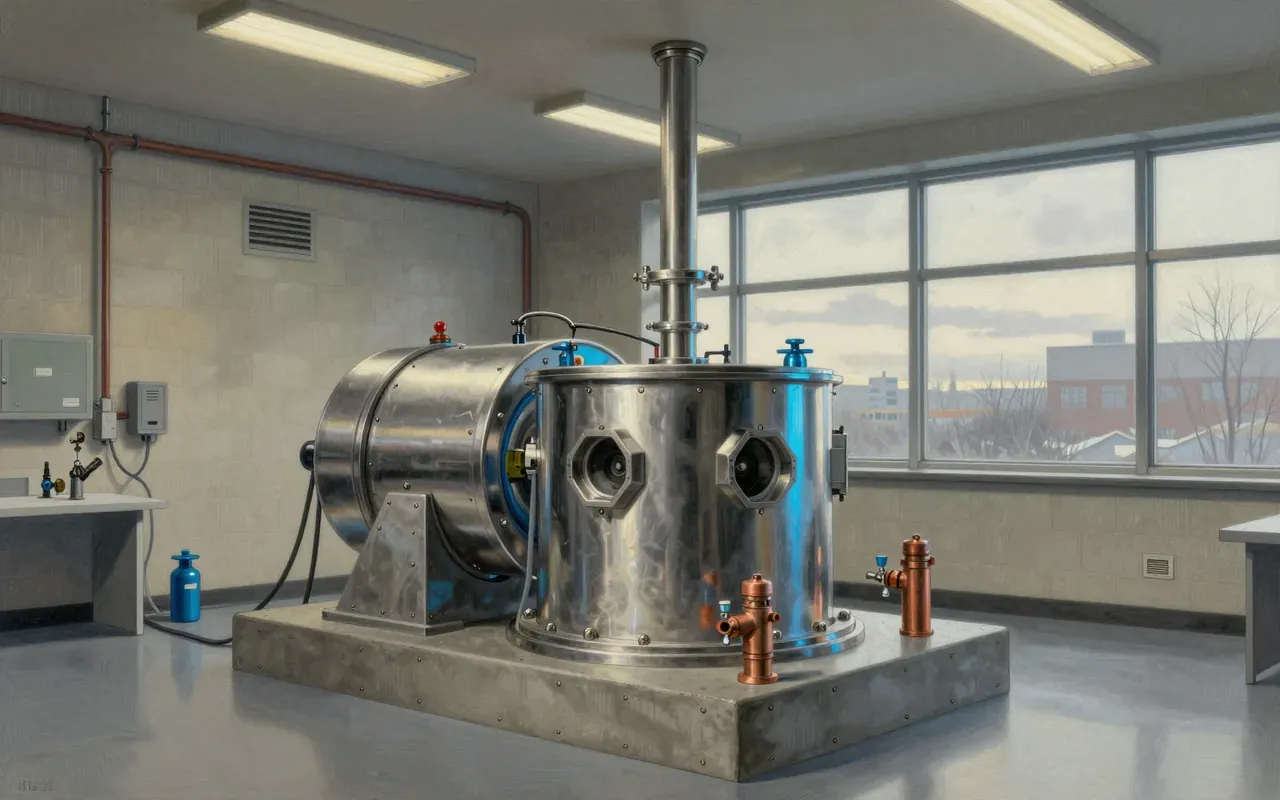
Ultracentrifuge

It didn’t reveal life’s blueprint — it gave biologists the first tool to hold molecules still enough to weigh them.

The ultracentrifuge is not a window into molecular structure — it is a force calibrator. Its value lies in reproducible, scalable pelleting and separation under defined g-fields. Its limitations — thermal drift, convection, rotor failure — are not flaws but boundary conditions that define what sedimentation data can and cannot say.

Chapters & takeaways4
  1. 1:03
    A name before a standard

    Svedberg named his 1924 device the 'ultracentrifuge' to distinguish it from the ultramicroscope — not because it was faster, but because it operated at a new scale of force.

  2. 2:37
    From 7,000 g to 100,000 g

    By 1926, Svedberg pushed centrifugal fields from 7,000 g to 100,000 g — a fourteen-fold increase enabled by mechanical redesign, not just speed.

  3. 4:28
    Vacuum as a measurement condition

    Pickels’ 1935 vacuum fix did more than cool rotors — it removed convection, making sedimentation rates physically interpretable for the first time.

  4. 6:18
    Pellet or separate: two jobs, one machine

    Preparative ultracentrifuges pellet organelles; analytical versions use gradients — two distinct modes, both dependent on precise g-force control.

Worth your time?

Yes. Study the whole thing.

4.5/ 5
What works
  • pelleting organelles
  • gradient separation of macromolecules
  • quantifying sedimentation coefficients
What does not
  • prove molecular identity
  • resolve atomic structure
  • eliminate all experimental artefacts
Study it if
  • biochemists
  • molecular biologists
  • polymer scientists
Skip it if
  • geneticists relying on sequencing
  • structural biologists using cryo-EM
  • physicists studying fundamental forces
The written brief1 min read

What the work claims

The ultracentrifuge is an instrument optimised for spinning rotors at very high speeds to generate accelerations up to 100,000 g.

How it was done

Theodor Svedberg built the first device named ‘ultracentrifuge’ in 1924, spinning at 12,000 rpm to generate 7,000 g. He then constructed a new version between 1925 and 1926 capable of 42,000 rpm and 100,000 g. Edward Greydon Pickels vacuumized the system in 1935 to reduce friction-induced overheating.

What holds up

The ultracentrifuge enables pelleting of mitochondria, microsomes, ribosomes, and viruses. It supports gradient separations using density gradients. Vacuum systems maintain constant sample temperature and eliminate convection currents that distort sedimentation interpretation.

What does not

It does not prove molecular structure or function. It does not resolve individual atomic positions. It does not operate without vacuum-induced thermal control or rotor stability limits.

Why it matters beyond the lab

It made possible the physical separation of biological components before sequencing or imaging existed — turning biochemistry from inference into isolation-based experiment.

Is it worth your time

Yes — it remains foundational for isolating macromolecules and organelles, and its engineering constraints directly shaped how sedimentation data are interpreted in molecular biology.
Same field · Engineering4 of 36
Up next in Science

Very Large Array

1980 · 9:28

The VLA did not invent radio interferometry — it weaponised reconfigurability.

9:28